Concha Negra: The Mangrove Oyster in Panama
Updated: Jul 30
La concha negra es el mar que te entra por la boca
— popular saying from the Panamanian Pacific coast
You may have seen Concha Negra on one of the menus in a Panamanian restaurant. Even if you speak Spanish, you may not know exactly what ‘black shell’ means until you taste it...Even then...you most probably don’t know where it comes from or what it took to get from mangrove to plate. Our video here is a quick guide to showing some of the trials and tribulations of bringing this amazing shellfish to the tip of your fork.
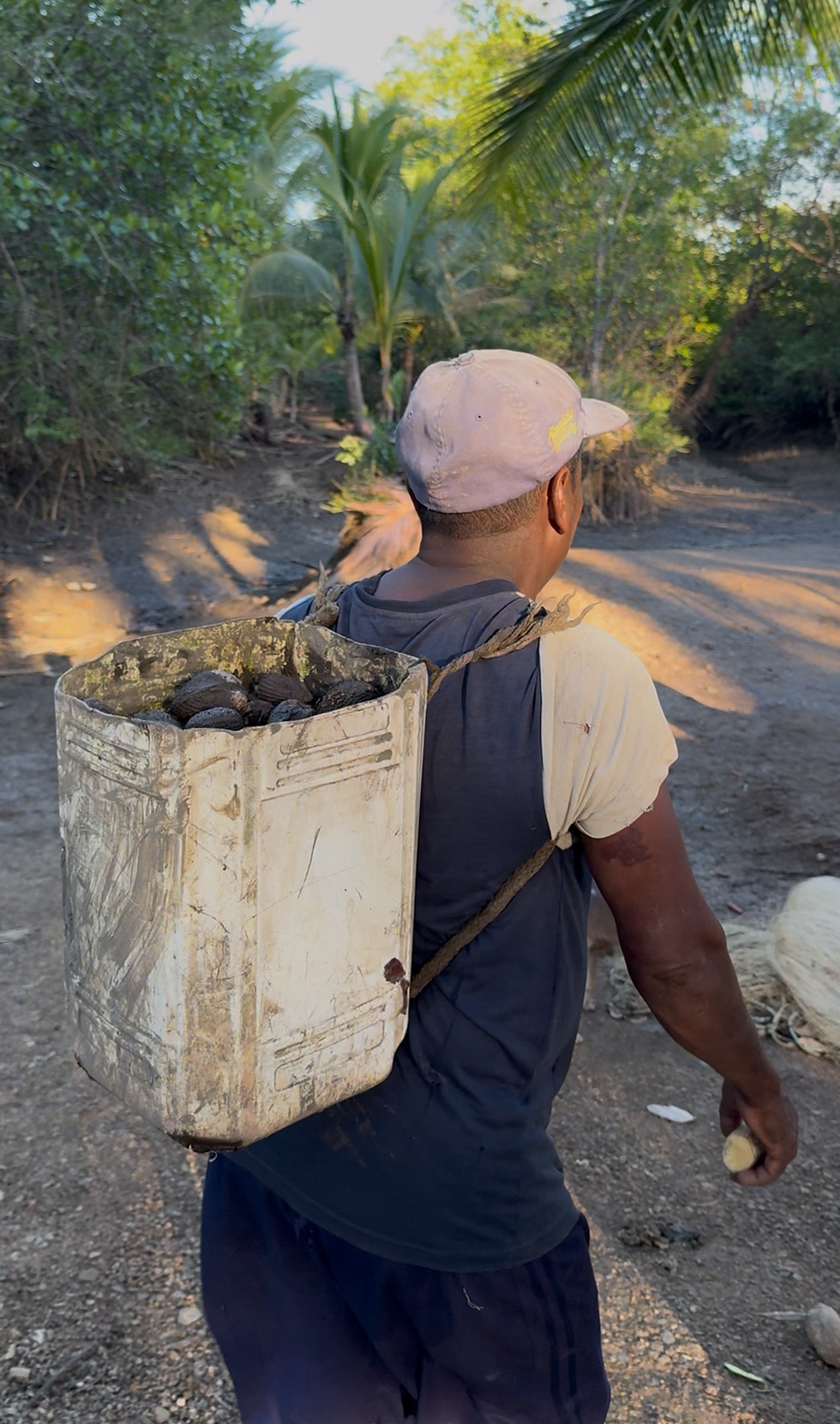
In our video we seek out Reynaldo, a ‘casador de concha’….the Concha hunter. He lives in a nearby community and has a reputation of being the best concha hunter in the greater area. Our group from Lago Bay marching down into the port of Tigre Amarillo where Reynaldo usually starts and ends his daily journey to help bring concha to the restaurants of Santa Catalina.
The Mangrove Oyster : the Concha Negra
The concha negra lives buried in the mangrove mud along the Latin American Pacific, from Mexico to Peru. In Panama it’s especially common in the provinces of Chiriquí, Veraguas, and the Azuero Peninsula, and its appearance is unmistakable: a ribbed shell in shades of black and gray, with flesh that’s dark, almost purple.
In Panama, its presence has been documented since pre-Columbian times. Archaeological sites on the Azuero Peninsula and along the coastal provinces have uncovered fossilized shell mounds — known as concheros — proving that indigenous populations were eating this mollusk centuries before Europeans ever arrived. It wasn’t just food. It was survival.
The rarity that surprises everyone: the concha's red blood
Almost all mollusks have colorless or bluish hemolymph. The concha negra is different. Its blood is red because it contains hemoglobin, the same protein that carries oxygen through the blood of vertebrates. This is an extraordinary rarity in the world of bivalves, shared by only a handful of other species.
That characteristic has a direct and very visible consequence: the flesh is dark, almost wine-colored, and the liquid it releases when opened stains everything it touches a deep purple. For someone who’s never seen it before, the first time can be genuinely disorienting.
The high iron content this produces makes it an extraordinarily nutritious food — superior to many red meats in terms of mineral concentration. Iron, zinc, vitamin B12, complete proteins. Coastal Panamanian communities, who have historically had limited access to red meat, have drawn enormous benefit from this small mud mollusk. It’s no coincidence that folk tradition attributes tonic properties to it and, inevitably, aphrodisiac ones too. That last reputation, hard to verify scientifically, has done plenty to boost its fame in fish markets and seafood bars across the country.
How to eat the hearty Mangrove Oyster
The most basic way to eat it is raw ‘on the half shell’, with lime and hot sauce. You pry open the shell with a knife, squeeze on plenty of lime juice, add a few drops of local chili sauce, and knock it back in one bite. At fish markets in Panama City, in Pedasí, in Santiago de Veraguas, you’ll find plenty of ceviche de conchas negras — where marinating in lime with red onion, cilantro, and aji chombo creates a more common snack. Probably the favorite dish in Panama for concha negra is a sautéed version with garlic and butter on a bed of rice. I personally like to cut up the concha in small pieces for Italian-style pasta. The concha absorbs the oregano, basil and red sauce and makes for an incredible and healthy meat substitute.

The Conchadores: Concha Hunters in Panama
You can’t talk about conchas negras without talking about the people who harvest them. The harvesting of conchas negras is called concheo, and its a job remanded from generation to generation.
It’s not easy work. Mangrove mud can be unstable and deep, full of venomous snakes, ray sting fish, wasps. The heat is intense and the pay has historically been very low. For decades this activity remained completely invisible, both economically and culturally. An unrecognized labor performed by women and men already on the margins of society.
Reynaldo in our video shows a glimpse of a day in the mangroves of Veraguas where he hunts concha from the Port of Tigre de los Amarillos.
The Trials and Tribulations in the Heart of the Mangrove
In the video, Reynaldo along with his love for the task of hunting for concha also shares several of his concerns and some of his hardships that are associated with concha hunting deep in the mangroves. He starts some of his explanation on a metaphysical front. There is a local ghost in the mangrove near Tigre de los Amarillos called Tulivieja. She is a violent entity that moves around their corner of mangrove instilling fear and respect. Shape shifting and affecting weather and transmitting fear and delusions have helped create a fairly wicked reputation. To ward off Tulivieja, the locals sometimes turn their cloths inside out and walk backwards out of the mangroves to keep her at bay.
On a more mundane level, hardships in the mangroves include a lot of bugs. Not just mosquitos and ‘no-see-ems’ (chitras), but also wasps, biting ants and all sorts of creepy crawlies. Combine snakes, alligators and a special fish that has a stinger like scorpions and you’ve combined quite a few obstacles for your daily hunt. The American Salt-Water Crocodile can easily reach lengths of 12 feet. In 2006 (the year that we started Lago Bay) I recall a record setting 27.5 foot Saltwater Crocodile that was captured (killed) by one of the neighboring communities. By any standards that was considered an amazing dinosaur of the mangrove. Reynaldo has to keep an eye for not only himself but his faithful dog companion as well. I’ve never heard of a fatal incident of man meets alligator in the area. Dogs are considered part of the food chain in the perspective of alligators and crocodiles. To be fair...alligators and crocodiles are certainly square on the menu in the local communities. Like in Cajun cuisine it is prized for many local dishes. But...this article is about concha negra.

The Cultural Comeback: From Mangrove to the Gourmet Menu
There’s a beautiful irony in the concha negra’s recent history. After centuries of cultural invisibility, after being written off as second-rate food compared to the lobsters and shrimp that ended up on tourist restaurant tables, the concha negra is having a moment.
The new generation of Panamanian chefs — raised on the Latin American culinary revival movement, inspired by figures like Gastón Acurio in Peru or Jorge Vallejo in Mexico — has rediscovered this mollusk as an authentic symbol of national culinary identity. Not as an exotic curiosity to be served with a passion fruit foam, but as an ingredient to be treated with respect, its story told at the table.
Some restaurants in Panama City now include conchas negras on their tasting menus. This isn’t just gastro-tourism — it’s a political statement. It’s a way of saying that a nation’s cuisine isn’t only the food of its colonizers, isn’t only the food of skyscrapers and business deals, but is also the food of women in the mud at dawn, of fish markets that smell like salt and life, of lime juice splashed over a very subtle smell of mangrove
One Mollusk, A Thousand Stories — Concha Negra in Panama
Concha Negra is a ‘must try’ if you’re traveling around Panama experiencing the places, the culture, the customs...and the food. You can’t find Concha Negra outside of the tropics. It is certainly a discovery that should be of interest along your Panama journey if you enjoy shellfish. In this little corner of the world near Lago Bay, concha negra is plentiful, inexpensive and sustainable. The local market sells concha negra at $3 per pound. It takes a little practice to prepare this special mollusk but once you get a good recipe down, concha negra is a fantastic addition to our local menu.
Many thanks for taking this short adventure with Reynaldo and the Lago Bay crew.
If you would like to visit Lago Bay and stay at one of our vacation homes, please visit:
Saludos from Lago Bay!!!

Comments